International Schools in Switzerland: The 2026 Family Guide
A calm, honest guide for families relocating to Switzerland, written for parents who don't yet know what they don't know about Switzerland's school landscape.
Quick Summary
- ·Switzerland is the world's deepest market for premium boarding schools, a small country with over 100 international and boarding schools, many founded in the 19th century, serving globally mobile families and dynastic wealth.
- ·Curricula split between the IB Diploma, the Swiss Maturité, British IGCSE/A-Level, American High School + AP and the French Baccalauréat. Many schools offer two or three pathways under one roof.
- ·Tuition for day schools typically runs CHF 25,000–45,000 (~US$28,000–US$50,000); full boarding at premier institutions runs CHF 80,000–130,000+ (~US$90,000–US$145,000+) all-in.
- ·Top-tier boarding schools (Le Rosey, Aiglon, Beau Soleil, Brillantmont, Institut auf dem Rosenberg) often have 12–24 month waitlists for popular years; sibling and legacy admissions are real.
- ·Where you live, Geneva / Vaud / Zug for international day schools, the Vaud Riviera and Bernese Oberland for boarding, is shaped by canton, language and which school admits your child.
- ·InternationalSchools.org sends you a curated shortlist, and those schools then reach out directly so you're not chasing admissions offices. Sharing is limited to your shortlist, never the wider network.
Why families relocate to Switzerland
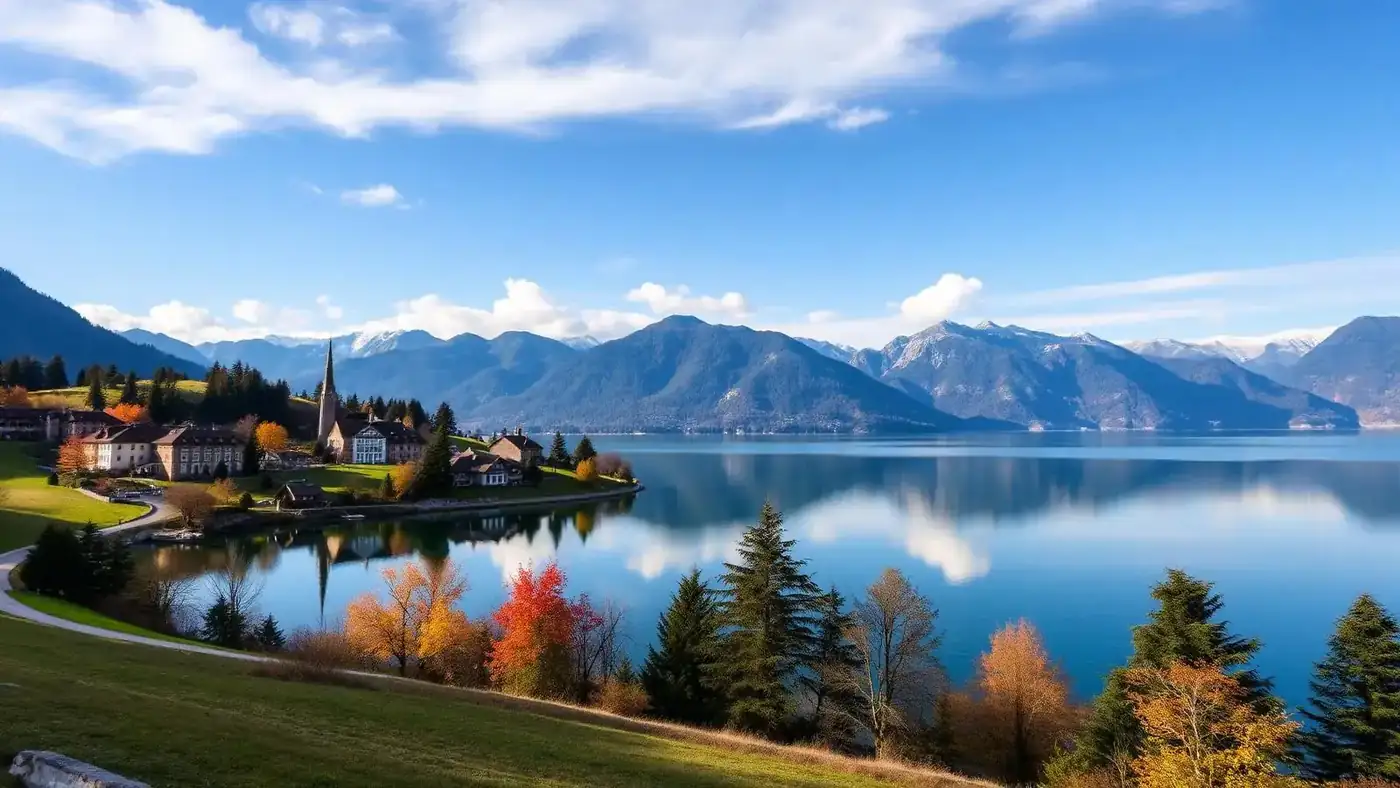
Switzerland is unusual: a country roughly the size of the Netherlands with arguably the highest concentration of premium schools in the world, four official languages, and a federal system where each canton runs education differently. For relocating families it offers an unusually deep menu of academic, linguistic and lifestyle options, but choosing well requires understanding the canton, the language pathway and the difference between truly international schools and schools that merely use the name.
Heritage of premium education
Switzerland's boarding tradition dates to the mid-1800s. Schools like Institut Le Rosey, Aiglon College, Beau Soleil and Institut auf dem Rosenberg have multi-generational alumni networks that meaningfully shape university and career trajectories.
Multilingual by default
Children in Swiss international schools typically grow up trilingual or quadrilingual, English plus French / German / Italian depending on canton, often plus a heritage language. This is one of the strongest linguistic environments globally.
Safety, healthcare, stability
Switzerland consistently ranks at or near the top of global indices for personal safety, healthcare quality, political stability and rule of law, all material when you're entrusting a school with your child for years.
Geography for mobility
Geneva, Zurich and Basel airports put London, Paris, Frankfurt, Milan and Madrid within 90 minutes, and most major US East Coast cities one direct flight away. Holidays and grandparent visits are unusually easy.
University outcomes
Swiss schools place graduates at Oxbridge, Ivy League, top US liberal arts, ETH/EPFL, LSE, Imperial, McGill and the leading European universities, with strong support for both UCAS and US application cycles in parallel.
Family-first culture
Outdoor sport, mountain access, ski programmes and an unhurried family rhythm distinguish Swiss school life. For families coming from intense urban environments, the lifestyle shift is part of the value proposition.
Families like yours land in Switzerland every month
Most arrive juggling a relocation, a new job, and a school search at the same time. A real person at InternationalSchools holds the school side for you, so the rest of the move feels lighter.
The international school landscape in Switzerland
Switzerland has roughly 100 international, bilingual and boarding schools across its 26 cantons. Education is a cantonal competence, there is no single national regulator like KHDA or Ofsted. Instead, each canton's department of education authorises and inspects schools, while quality assurance for international curricula comes from accreditors such as the Council of International Schools (CIS), New England Association of Schools and Colleges (NEASC), Council of British International Schools (COBIS) and the IB Organisation. The Swiss Federation of Private Schools and the Swiss Group of International Schools (SGIS) provide additional sector oversight.
The market splits clearly into three categories. Day schools (often called 'international schools') cluster around Geneva, Lausanne, Zurich, Zug and Basel, driven by UN agencies, multinationals, banking and pharma. Boarding schools concentrate along the Vaud Riviera (Lake Geneva), the Bernese Oberland and selected alpine villages. Bilingual private day schools (Swiss Maturité or French/German national curriculum with English streams) operate alongside both, and are often a strong-value option for families committed to long-term residency.
Premium boarding is genuinely premium: full boarding at flagship institutions can exceed CHF 130,000 per year. Fees include accommodation, all meals, weekend programmes, and most extracurriculars and ski weeks. These schools typically have 60–90% boarding ratios, intentionally small student bodies (200–500 total), and student–teacher ratios under 6:1.
International day schools are more comparable to other major hubs (Singapore, Dubai, London) in pricing and structure. The largest, International School of Geneva (Ecolint), International School of Lausanne (ISL), Inter-Community School Zurich (ICSZ), Zurich International School (ZIS), International School of Zug and Luzern (ISZL), operate multiple campuses and offer the IB across all three programmes.
Which curriculum suits your family?
Switzerland offers the broadest curriculum menu of any country in this guide. The right one depends on your child's likely university destination, your residency plans, and whether you want them to acquire a second working language at native level.
| Curriculum | Best for families who… | University recognition | Notes |
|---|---|---|---|
| IB (International Baccalaureate) | Globally mobile families wanting a portable, broad curriculum aligned to top universities worldwide. | Recognised by every major university; particularly strong for selective US, UK, Canadian, Swiss and European admissions. | Switzerland is one of the deepest IB markets in the world; the IB itself was founded in Geneva in 1968. |
| Swiss Maturité | Families settling long-term in Switzerland; route to Swiss universities (UNIGE, ETH, EPFL, USI). | The gold-standard Swiss school-leaving qualification; recognised across Europe and increasingly in the US. | Bilingual French/German + English Maturités exist; demanding, multi-language, ideal for committed long-term residents. |
| British (UK), IGCSE / A-Level | Families targeting UK / Commonwealth universities or rotating between British international schools. | Strong for UK, Australia, Canada, Hong Kong, Singapore admissions. | Several major boarding and day schools follow the British system, sometimes alongside IB. |
| American (US), High School + AP | Families targeting US universities or returning to American-curriculum schools after Switzerland. | US High School Diploma plus AP courses widely accepted; transcripts portable within the US system. | Concentrated in a smaller set of American international schools and several boarding schools with US streams. |
| French Baccalauréat | Families maintaining the French national system or planning return to France. | Recognised across the francophone world and accepted by most international universities. | Strong presence in Geneva, Vaud and the Lake Geneva region given French-Swiss cultural overlap. |
Honest tuition expectations
Annual fees in Switzerland vary widely by school tier and curriculum. The figures below are headline tuition, there are almost always additional costs you should plan for.
- Bilingual private day (Maturité-track, primary)$18,000 – $30,000Strong long-residency value; trilingual environment; typically lower than international day schools.
- International day schools (IB / British / American)$28,000 – $48,000Geneva, Lausanne, Zurich, Zug, Basel; senior years priced higher than primary.
- Premium boarding, weekly / 5-day$60,000 – $90,000Boarding 4–5 nights per week; available at several Vaud and Bernese schools.
- Premium boarding, full (flagship)$95,000 – $145,000+All-inclusive: accommodation, meals, weekend programmes, ski weeks, most extracurriculars.
- · Application fee (CHF 200–500) per school
- · Refundable deposit (CHF 5,000–25,000 at boarding schools)
- · One-off enrolment / capital fee (CHF 2,000–15,000)
- · Ski week, mountain trips, expedition programmes (CHF 1,500–5,000/year)
- · Uniforms or dress code items, laptops/iPads (CHF 1,000–3,000/year)
- · School transport / weekend travel for boarders (variable)
- · IB / A-Level / AP exam fees (CHF 1,000–2,500 in senior years)
- · Health insurance and mandatory Swiss LAMal cover for resident families
When to apply, and what to prepare
Most Swiss schools open applications 12 months ahead. Premier boarding schools, particularly in Vaud and the Bernese Oberland, frequently have 12–24 month waitlists for Y7/G6 and Y9/G8 entry. Day schools are more flexible, with rolling admissions through the year and meaningful turnover from expat rotation.
- 12+ months outShortlist & visitIdentify 5–8 schools across two tiers and across day vs boarding if relevant. For boarding, plan an in-person visit, tone, dorm life and weekend programme matter as much as academics.
- 9–12 months outSubmit applicationsMost schools accept applications via online portal with an application fee. Provide last 2–3 years of school reports, passport copies, current school contact for reference, and any educational psych / SEN reports.
- 6–9 months outAssessments & interviewsYounger years use play-based observation. Y3+ typically use CAT4 or in-house literacy/numeracy. Boarding schools and selective day schools require a Zoom or in-person interview, both child and parents.
- 3–6 months outOffers, deposits, contractsOffers usually arrive with a 14–30 day acceptance window plus a non-refundable enrolment fee and a sizeable refundable deposit (especially at boarding schools).
- 1–3 months outPermits, housing, onboardingOnce your B / L / G permit is issued, finalise housing within the school's catchment, complete medical and vaccination forms, and register with the canton. For boarders: confirm uniform and dorm-room kit lists.
- Mid-year alternativeJanuary startMost international day schools accept January entry, especially at primary; boarding mid-year placements are rarer but possible at lower-demand year groups.
Neighborhoods most expat families consider
Switzerland's geography matters. Different cantons have different languages, tax regimes and school clusters. Below are the regions families most often consider, grouped by character and by the schools each region typically serves.
French-speaking, international by default. Home to UN agencies, banking, watchmaking, NGOs. Strong international day schools and adjacent premium boarding.
German-speaking, finance and tech hub (Google, banking, crypto, multinationals). Family-friendly suburbs with excellent international day schools.
Trilingual French / German / English region anchored by pharma (Roche, Novartis). Smaller, focused international school market.
Premium boarding country: alpine villages purpose-built around international boarding schools, with ski-in/ski-out programmes and tight student communities.
Lakeside towns hosting flagship boarding institutions and quieter family communities; strong rail links to Geneva and Lausanne.
Italian-speaking southern Switzerland; smaller market with a few well-regarded international and bilingual schools, popular with Italian and Russian-speaking families.
Beyond the school: relocation basics
The notes below are general orientation, not legal or tax advice. Always confirm current requirements with official government sources.
Permits & residency
EU/EFTA citizens typically receive a B permit on employment. Non-EU citizens go through a quota system tied to a Swiss employer or, for HNW families, a lump-sum taxation arrangement (forfait fiscal) negotiated with the canton. Talk to a Swiss immigration lawyer early, timelines vary materially by canton and nationality.
Healthcare (LAMal)
Swiss healthcare is mandatory private insurance (LAMal) per family member, with monthly premiums roughly CHF 250–600 per adult and CHF 80–150 per child. It is a real, recurring cost separate from school fees. Top up with private supplementary cover for international hospital and dental care if needed.
Housing
Rentals are tight, especially in Zurich, Geneva and Zug. Expect 3 months' deposit and significant supporting documentation (employer letter, debt enforcement extract). Many boarding-school families maintain a smaller pied-à-terre nearby for visits and exeat weekends.
Banking & taxation
Cantonal taxation differs sharply (Zug and Schwyz are notably lower than Geneva and Vaud). For HNW relocations, lump-sum taxation is negotiated by canton and is materially relevant to total cost-of-living planning.
Schooling logistics
International schools and Maturité schools require last 2–3 years of reports, passport copies, vaccination records and (for SEN) educational psych reports. Boarding schools require additional medical, allergy and dietary disclosures plus emergency contact and guardianship arrangements for non-resident families.
Transport & access
Switzerland's rail network is exceptional, most boarding schools include weekend travel coordination via SBB. Day-school families largely use car + train; bus catchments matter most in Geneva/Vaud and Zurich.
Common mistakes families make in Switzerland
- Confusing 'international school' branding with genuine accreditation, always verify CIS / NEASC / COBIS / IB accreditation directly.
- Underestimating the difference between weekly and full boarding, your child's weekends and holiday plans are the real differentiator at flagship schools.
- Picking a canton without considering tax regime, total cost-of-living planning matters as much as tuition for long-term residents.
- Relying on legacy reputation without reading recent inspection or accreditation reports.
- Missing the early-application window for premier boarding (Le Rosey, Aiglon, Beau Soleil), these schools genuinely fill 12–24 months ahead at popular years.
- Underestimating CHF appreciation risk, fees are denominated in CHF and have appreciated meaningfully against USD/EUR over the last decade.
- Choosing a boarding school based on glossy marketing rather than dorm life, weekend programmes and student community fit, visit if at all possible.
- Forgetting that mandatory LAMal health insurance and Swiss living costs add 25–40% on top of headline tuition for resident families.
Tell us what your family needs in Switzerland
Reviewed by a real person. You'll receive a curated shortlist, and, per the consent you give on the form, we share your details with those shortlisted schools so they can contact you directly.
Your Switzerland school shortlist
Tell us about your child in ~2 minutes. A real person reviews every submission and prioritises families with upcoming school starts.
- Human reviewed
- Global coverage
- Free for families
- Privacy-first
GDPR · consent-based. Your details are only shared with the schools on your shortlist.
International schools in Switzerland, common questions
Honest answers to the things parents most often worry about, timing, fit, privacy, and what happens the moment you hit submit.
- Advisor-reviewed
- Zero spam, opt-in only
- Reviewed by a real person
- International day schools typically run CHF 25,000–45,000 (~US$28,000–US$50,000) per year. Premium full boarding at flagship institutions runs CHF 80,000–130,000+ (~US$90,000–US$145,000+) all-inclusive. Add 15–25% buffer for fees, deposits, ski weeks, transport and exam fees.
- Boarding schools house students 5–7 nights per week with full weekend programmes, typically 60–90% boarders. Day schools follow a normal school day with home pickup. Boarding fees include accommodation, meals, ski weeks and most extracurriculars; day school fees do not.
- The IB Diploma is the most widely offered international curriculum (the IB itself was founded in Geneva). The Swiss Maturité is the national gold standard. British IGCSE/A-Level and US High School + AP are also widely available. Many schools offer two or three curricula in parallel.
- Premier boarding schools (Le Rosey, Aiglon, Beau Soleil, Institut auf dem Rosenberg) often fill 12–24 months ahead at Y7/G6, Y9/G8 and Y12/G11. As soon as you're seriously considering Switzerland, start the shortlist process, visits, interviews and assessments take time.
- Geneva and Vaud have the deepest international school market; Zurich and Zug have the strongest combination of international day schools and tax efficiency; Basel suits pharma families; Vaud alpine villages and the Bernese Oberland are home to most premium boarding. Match canton to language preference, employer base and tax planning.
- International day schools operate in English with second-language programmes. Children quickly absorb the local language through extracurriculars and friends. Bilingual / Maturité schools require working competence in the cantonal language by senior years.
- Several international and boarding schools have well-resourced learning support / SEN departments, with dedicated admissions processes. Provision varies widely, share any educational psych reports early so we can shortlist schools with the right model.
- A few schools accept boarders from age 7 or 8, but most start full boarding from Y6/G5 or Y7/G6. Weekly boarding from earlier years is more common. Family fit and the child's readiness matter as much as the school's policy.
- It's an excellent choice if you're settling long-term in Switzerland and want strong access to Swiss universities (ETH, EPFL, UNIGE, USI). For families likely to relocate again, IB or British/American pathways are more portable.
- International schools follow August/September–June. Boarding schools typically have three terms separated by autumn, Christmas, ski/Easter and summer breaks. Ski week (semaine blanche) in February or March is a standard feature.
- Yes, Swiss international and boarding schools place strongly at Oxbridge, Ivy League, top US liberal arts colleges, ETH/EPFL, LSE, Imperial, McGill and leading European universities. Most run dedicated UCAS and US application support in parallel.
- IB and British curricula are the most portable choices. Boarding schools generally offer strong international transcript support. We can flag schools with strong transfer support to common next destinations like London, Singapore, Dubai and the US.
Reviewed by InternationalSchools.org Editorial Team
Independent international school guidance, reviewed by relocation specialists. Last verified May 2026. We refresh this guide quarterly.