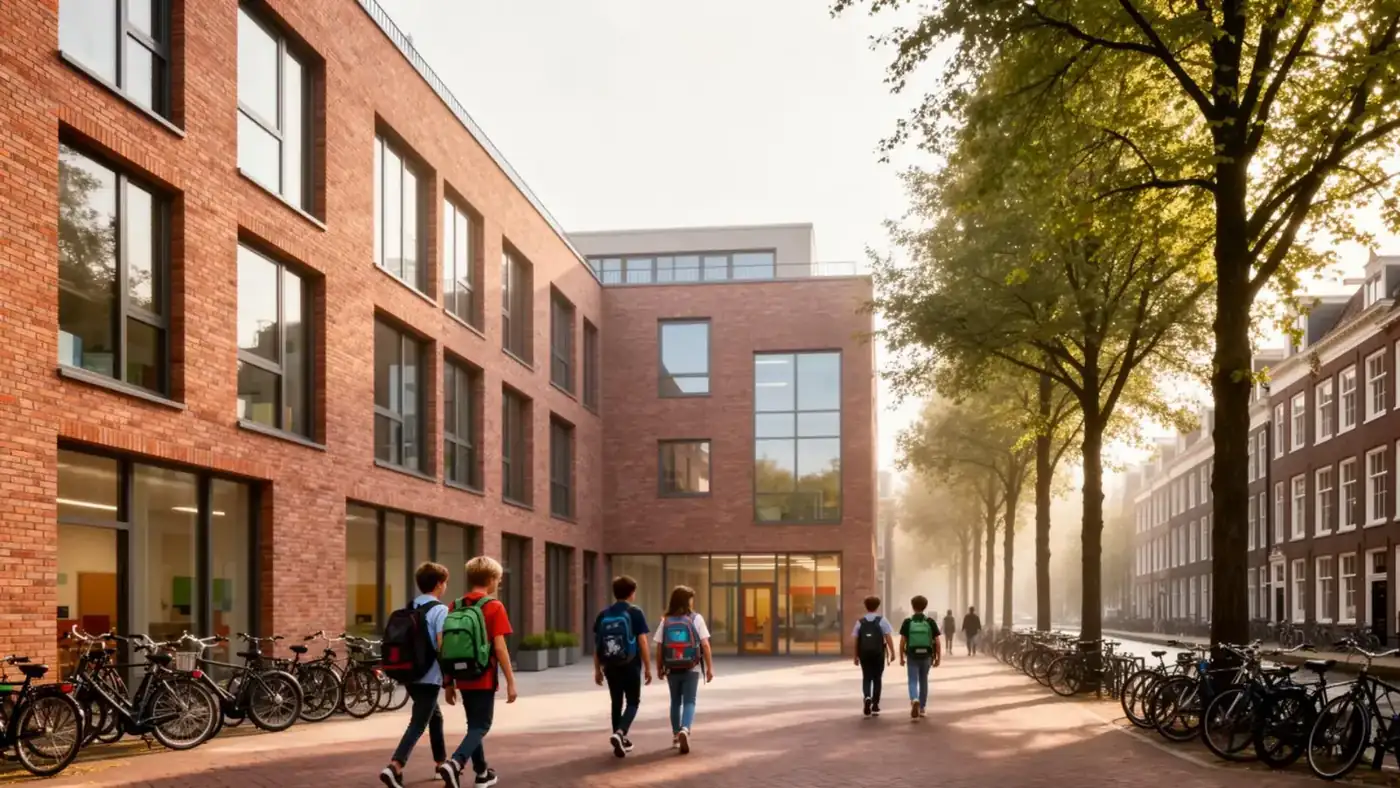
International Schools in Amsterdam: The 2026 Family Guide
A calm, honest guide for families relocating to Amsterdam, written for parents who don't yet know what they don't know about Netherlands's school landscape.
Quick Summary
- ·Amsterdam offers a unique two-tier international school market: government-subsidised Dutch International schools (DSTC), where fees are €5,000–€8,000/year, and fully private international schools at €15,000–€25,000+/year.
- ·Roughly 25 international or international-stream schools serve greater Amsterdam, dominated by IB and Dutch International curricula, with British, American, French, German and Japanese options.
- ·Subsidised DSTC schools (e.g. Amsterdam International Community School, International School of Amsterdam, primary streams) are oversubscribed: 0–18 month waitlists are common, and eligibility usually requires international employer / time-limited residency.
- ·Most expat families settle in Zuid (south), Amstelveen, the canal belt or Haarlem, choice driven by school catchment, the 30%-ruling tax framework and access to Schiphol.
- ·The Netherlands' 30%-ruling has been progressively scaled back (2024 reform: 30/20/10 phasing; further changes from 2027), model your specific situation before relocating.
- ·InternationalSchools.org sends you a curated shortlist, and those schools then reach out directly so you're not chasing admissions offices. Sharing is limited to your shortlist, never the wider network.
Why families relocate to Amsterdam
Amsterdam has been the quiet success story of European family relocation for two decades. English is the de facto second language, the city is small and walkable, healthcare and public infrastructure are excellent, and the international school market is unusually well-organised, including a government-subsidised stream (DSTC) that no other major European capital offers at the same scale. The Netherlands' tax framework remains attractive for skilled migrants despite recent reforms, and Schiphol gives families fast access to almost every European and global hub.
English-friendly daily life
Roughly 90%+ of Amsterdammers speak fluent English. Schools, GPs, services, professional life and government correspondence are all reliably accessible without Dutch, though learning Dutch helps for long-term integration.
Subsidised DSTC schools
The Dutch International Schools (DSTC) network is partially government-funded, offering high-quality international primary and secondary education at €5,000–€8,000/year, uniquely affordable for a Western European capital. Eligibility typically requires international employer or time-limited Dutch residency.
Tax framework (30% ruling)
The 30% ruling allows qualifying skilled migrants to receive 30% of their gross salary tax-free. The 2024 reform introduced a 30/20/10 phasing over 5 years, and further changes from 2027 are under consultation. Materially affects net cost-of-living, model carefully before relocating.
Compact, family-friendly city
Cycling infrastructure, parks (Vondelpark, Beatrixpark, Amsterdamse Bos), short school commutes, low crime and excellent paediatric and family healthcare make daily life with children genuinely calm.
Schiphol and European mobility
Schiphol is one of Europe's best-connected hubs, direct flights to almost every major European, North American and Asian city. Weekend mobility for globally distributed families is materially easier than from inland European capitals.
EU residency pathway
Skilled-migrant, EU Blue Card and DAFT (Dutch-American Friendship Treaty) routes provide credible long-term residency options, with a 5-year path to permanent residency and Dutch citizenship eligibility.

Families like yours land in Amsterdam every month
Most arrive juggling a relocation, a new job, and a school search at the same time. A real person at InternationalSchools holds the school side for you, so the rest of the move feels lighter.
The international school landscape in Amsterdam
Amsterdam's international school market is regulated by the Dutch Inspectie van het Onderwijs and split into two distinct tiers. The government-subsidised tier, Dutch International Schools (DSTC), is partially funded by the Ministry of Education and offered through specific Dutch state and special schools that meet international-curriculum criteria. The fully private tier operates as standalone international schools accredited by CIS (Council of International Schools), the IB Organisation, COBIS and similar bodies.
Roughly 25 international or international-stream schools serve greater Amsterdam. The most-asked-about include the International School of Amsterdam (ISA, Amstelveen, full IB continuum, fully private), Amsterdam International Community School (AICS, multiple campuses across Amsterdam, DSTC subsidised), British School of Amsterdam (Zuid, UK curriculum), Amity International School Amsterdam (Amstelveen, private IB), Optimist International School (DSTC primary), Lycée Vincent van Gogh (French), Japanese School of Amsterdam, Deutsche Schule Den Haag (nearby), and the European School of The Hague (specialist EU institutions).
DSTC eligibility typically requires that the family is in the Netherlands on a time-limited international assignment (international employer, expat package) or has a clear international background. Children of long-term Dutch residents may be ineligible for DSTC streams and routed instead toward Dutch national schools or fully private internationals.
Demand has tightened materially since 2020. AICS and other DSTC schools at popular year groups now run 6–18 month waitlists, particularly at primary entry and the move into secondary. Fully private internationals (ISA, BSA, Amity) have shorter waits but materially higher fees. Plan 6–12 months ahead.
The IB curriculum dominates: ISA, AICS, Amity, Optimist and others all offer some combination of PYP, MYP and DP. British (UK), French, German and Japanese pathways exist but are narrower. Dutch national schools also offer strong bilingual streams (TTO, Tweetalig Onderwijs) at secondary level, increasingly used by long-term resident expat families.
Which curriculum suits your family?
Amsterdam's curriculum landscape is concentrated in three pathways. Choose by university destination, your likely length of stay, and your child's existing curriculum, and remember that Dutch bilingual (TTO) streams at state schools are a strong option for families settling long-term.
| Curriculum | Best for families who… | University recognition | Notes |
|---|---|---|---|
| IB (International Baccalaureate) | Globally mobile families and students wanting a broad, portable diploma across sciences, languages, arts and CAS. | Accepted worldwide; particularly strong for selective US, Canadian, European, UK and Dutch admissions. | Dominant pathway in Amsterdam. ISA (full PYP–MYP–DP continuum), AICS (DSTC subsidised, MYP and DP), Amity, Optimist primary. |
| Dutch International (DSTC) | Internationally mobile families wanting a high-quality international curriculum at subsidised fees, eligible by employer/residency status. | Combines Dutch national qualifications with international components; IB Diploma offered at secondary level by most DSTC schools. | AICS, Optimist International, several other DSTC primary and secondary schools across Amsterdam and Amstelveen. |
| British (UK), IGCSE / A-Level | Families targeting UK universities or rotating between British international schools. | Reference standard for UK universities; broadly accepted globally. | British School of Amsterdam (BSA, Zuid), the principal UK-curriculum option; smaller British primary streams elsewhere. |
| French / German / Japanese | Families maintaining national-language continuity (Lycée Français, Deutsche Schule, Japanese School). | Baccalauréat, Abitur and Japanese diplomas are recognised internationally. | Lycée Vincent van Gogh (French), Japanese School of Amsterdam, Deutsche Schule Den Haag (commutable from Amsterdam south for some families). |
| Dutch bilingual (TTO) state schools | Long-term resident families wanting subsidised, high-quality bilingual education with Dutch national qualifications. | Dutch HAVO/VWO diplomas with bilingual English component; recognised across the EU and by global universities. | Multiple TTO state schools across Amsterdam and Amstelveen, strong value, requires Dutch language progression. |
Honest tuition expectations
Annual fees in Amsterdam vary widely by school tier and curriculum. The figures below are headline tuition, there are almost always additional costs you should plan for.
- Dutch bilingual (TTO) state schools$0 – $1,500State-funded; nominal voluntary parental contribution. Outstanding value for families settling long-term.
- DSTC subsidised international$5,000 – $9,000AICS, Optimist and other Dutch International schools. Government-subsidised; eligibility usually requires international employer / time-limited residency.
- Fully private international$18,000 – $28,000ISA, BSA, Amity, Lycée Vincent van Gogh at senior years.
- Capital, registration and one-off costs+$1,500 – $5,000Application fees, refundable / non-refundable enrollment deposits, uniforms (where applicable), bus, lunches and exam fees.
- · Application / assessment fees (€100–€500) per school
- · Refundable / non-refundable enrollment deposit (€500–€3,000+ at private internationals)
- · Uniforms (BSA and a few others), books, laptops/iPads (€300–€1,500/year)
- · School lunches and after-school clubs (€500–€2,500/year)
- · School trips, residentials, ski / international trips (€300–€2,500+/year)
- · IB / IGCSE / A-Level / DP exam fees in senior years
- · Dutch language tutoring (often valuable, particularly at DSTC schools and for long-term integration)
- · Health insurance, basic Dutch health insurance (verplichte basisverzekering) is mandatory and runs ~€140–€170/month per adult; supplementary cover optional
When to apply, and what to prepare
Amsterdam admissions are more flexible than London or Paris but materially tighter than they were 5 years ago at the popular DSTC schools. Plan 6–12 months ahead, and shortlist across both tiers (DSTC + private international). DSTC eligibility is usually checked at application, confirm your residency / employer status early.
- 12–18 months outResearch, eligibility & shortlistConfirm DSTC eligibility (international employer / time-limited residency). Identify the right neighborhood (Zuid, Amstelveen, canal belt, Haarlem) based on commute and housing. Shortlist 4–6 schools across DSTC + private tiers.
- 9–12 months outRegister and visitSubmit registrations at AICS (multiple campuses), ISA, BSA, Amity, Optimist and any other shortlisted schools. Many now operate waitlists, earlier registration improves position. Visit in person where possible.
- 6–9 months outAssessments & interviewsMost international schools use age-appropriate written assessments (CAT4, MAP) and a parent + child interview. Current school reports (last 2 years) and reference letters are required.
- 3–6 months outOffers, deposits, BSNOffer windows are short (often 14–30 days). Pay deposits to secure place. In parallel, register with the gemeente (municipality) to obtain BSN (citizen service number), required for almost everything including school enrolment finalisation, banking and health insurance.
- 1–3 months outHousing, health insurance, school logisticsSign rental contract within commute distance of the school. Arrange mandatory Dutch basic health insurance, register with a huisarts (GP), and (where relevant) confirm 30%-ruling application timing with employer.
- Mid-year alternativeJanuary / Easter startsMost international schools accept mid-year entry where space exists. DSTC schools typically have less mid-year flex than fully private internationals.
Neighborhoods most expat families consider
Most relocating families settle in one of four corridors. Amsterdam is small enough that almost any expat-friendly neighborhood is workable, but school catchment, the 30%-ruling timing and Schiphol access usually drive the choice.
Classic expat heartland, quiet, leafy, family-oriented, with Vondelpark and Beatrixpark close by. Walkable to BSA and easy commute to Zuidas (Amsterdam's business district).
Suburban municipality just south of Amsterdam, strong international community (large Indian, Japanese and American populations), purpose-built family housing, excellent international schools. Easy Schiphol access.
Historic canal-house living, premium central neighborhoods with strong walkability and bike access. Suits families wanting urban life.
Newer eastern districts, modern family housing, parks, water, and a younger expat / creative population. Good value vs Zuid.
Historic city 20 minutes by train from central Amsterdam, quieter, cheaper, family-friendly. Increasingly popular with relocating families wanting more space.
Wooded commuter belt south-east of Amsterdam, established expat community, larger family homes, easy train access to central Amsterdam.
Beyond the school: relocation basics
The notes below are general orientation, not legal or tax advice. Always confirm current requirements with official government sources.
Visas and residency
Most non-EU families enter on a Highly Skilled Migrant permit (employer-sponsored), EU Blue Card, intra-corporate transfer, DAFT (Dutch-American Friendship Treaty, for US entrepreneurs) or family-reunification route. EU/EEA citizens have free movement and register with the local gemeente. Engage a Dutch immigration lawyer early to confirm eligibility and timing.
30%-ruling and tax
The 30%-ruling allows qualifying skilled migrants to receive 30% of their gross salary tax-free. The 2024 reform introduced 30/20/10 phasing over 5 years (30% for years 1–2, 20% for years 3–4, 10% for year 5). Further changes from 2027 are under consultation. Confirm eligibility with employer and a Dutch cross-border accountant before relocating, it materially affects net household income.
BSN and gemeente registration
On arrival, register with the local gemeente (municipality) within 5 days to obtain a BSN (Burgerservicenummer, citizen service number). The BSN is required for almost everything: school enrolment finalisation, banking, health insurance, employment and tax. Bring passport, residence permit (if applicable), birth/marriage certificates (legalised/apostilled) and proof of address.
Healthcare
Dutch basic health insurance (verplichte basisverzekering) is mandatory for residents and runs ~€140–€170/month per adult. Children are covered free until 18. Most expat families also hold supplementary dental/physio cover. Register with a huisarts (GP) close to your home, they are the gateway to specialist and hospital care.
Housing
Amsterdam's rental market is tight, particularly in the €2,000–€4,500/month bracket. Many landlords require proof of employment, a Dutch bank account and 1–3 months' deposit. Most international families lease for 12–24 months; furnished options exist but are a premium. Consider Amstelveen, Haarlem or Hilversum for better value and family space.
Banking and admin
Open a Dutch bank account (ABN AMRO, ING, Rabobank, bunq) on arrival; most accept new-resident applications with BSN, passport and proof of address. DigiD (digital ID) is essential for almost all government and tax interactions, apply once you have a BSN.
Schooling logistics
International schools require last 2–3 years of school reports, reference from current head, passport copies and (where relevant) educational psychology / SEN reports. DSTC schools verify eligibility (international employer / time-limited residency). Most schools require a school place letter for visa or residence permit applications.
Common mistakes families make in Amsterdam
- Assuming DSTC eligibility, children of long-term Dutch residents may be ineligible for the subsidised stream and routed toward Dutch national schools or fully private internationals. Confirm eligibility before shortlisting.
- Underestimating waitlists at AICS and other popular DSTC schools, 6–18 months at popular year groups is now common. Apply early or shortlist across both tiers.
- Ignoring the 2024 30%-ruling reform, phasing (30/20/10) materially affects multi-year net household income. Model carefully with a Dutch cross-border accountant.
- Signing a 12-month lease before confirming a school place, Amsterdam's rental market is tight, but optimising housing around the school after the offer is a much better strategy.
- Forgetting to register with the gemeente within 5 days of arrival, without a BSN, almost nothing administrative works (banking, health insurance, school enrolment finalisation, tax).
- Underbudgeting at fully private internationals, total cost of education (registration, deposits, lunches, transport, exams) is typically 15–25% above headline tuition.
- Overlooking strong Dutch bilingual (TTO) state schools for families settling long-term, outstanding value, strong outcomes, deeper integration.
- Assuming Schiphol access is the same from every neighborhood, Amstelveen and Zuid are materially closer to the airport than IJburg or Haarlem; matters for globally commuting parents.
Tell us what your family needs in Amsterdam
Reviewed by a real person. You'll receive a curated shortlist, and, per the consent you give on the form, we share your details with those shortlisted schools so they can contact you directly.
Your Amsterdam school shortlist
Tell us about your child in ~2 minutes. A real person reviews every submission and prioritises families with upcoming school starts.
- Human reviewed
- Global coverage
- Free for families
- Privacy-first
GDPR · consent-based. Your details are only shared with the schools on your shortlist.
International schools in Amsterdam, common questions
Honest answers to the things parents most often worry about, timing, fit, privacy, and what happens the moment you hit submit.
- Advisor-reviewed
- Zero spam, opt-in only
- Reviewed by a real person
- DSTC subsidised international schools (e.g. AICS, Optimist) run €5,000–€8,000/year. Fully private international schools (ISA, BSA, Amity) run €15,000–€25,000+/year. Dutch bilingual (TTO) state schools are essentially free (small voluntary parental contribution). Add 15–25% buffer for deposits, uniforms, lunches, bus and exam fees at private internationals.
- DSTC (Dutch International Schools / Dutch International Stream) is a network of partially government-subsidised international schools. Eligibility typically requires that the family is in the Netherlands on a time-limited international assignment (international employer, expat package) or has a clear international background. Children of long-term Dutch residents may be ineligible. Confirm with each school and the Inspectie van het Onderwijs guidance early.
- Plan 6–12 months ahead for an August/September start at popular DSTC schools, earlier (12–18 months) at AICS at oversubscribed year groups. Fully private internationals (ISA, BSA, Amity) typically have shorter waits but materially higher fees. Mid-year entry is widely available outside bottleneck years.
- The IB curriculum dominates (PYP, MYP, DP across most international schools). British (UK) is offered principally at the British School of Amsterdam. French, German and Japanese pathways exist for national-curriculum continuity. Dutch bilingual (TTO) state schools combine the Dutch national curriculum with strong English instruction.
- The four main corridors are Amsterdam Zuid (Apollobuurt / Beethovenbuurt, classic expat heartland, walkable to BSA), Amstelveen (large international community, ISA / Amity / Japanese School), the canal belt (central, urban living, AICS Central) and Haarlem (20-min train, family value). Amsterdam Oost / IJburg and Hilversum are credible alternatives.
- Yes, but it has been reformed. The 2024 reform introduced a 30/20/10 phasing over 5 years (30% for years 1–2, 20% for years 3–4, 10% for year 5). Further changes from 2027 are under consultation. Confirm eligibility with employer and a Dutch cross-border accountant before relocating, it materially affects net cost-of-living.
- No, DSTC and fully private international schools deliver instruction primarily in English. However, most include Dutch as a second language (NT2). Children typically pick up conversational Dutch within 12–24 months, particularly at DSTC schools where Dutch culture and language are integrated. Dutch national / TTO schools require materially stronger Dutch.
- Yes, where space exists. Fully private internationals generally have more mid-year flex than DSTC schools. Bottleneck years (primary entry, move into secondary, IB Diploma start) are tighter, particularly at AICS.
- International schools follow an August/September–June calendar with three terms (Autumn, Spring, Summer). Dutch national / TTO schools follow the same structure. Holiday timings (especially the May break) vary slightly by region and school.
- Dutch national schools are state-funded and excellent value. TTO (Tweetalig Onderwijs) bilingual streams at HAVO and VWO secondary level combine Dutch national qualifications with strong English instruction, increasingly used by long-term-resident expat families. Requires children to develop Dutch language progressively.
- Provision varies materially by school, top international schools (ISA, AICS, BSA, Amity) have learning support / SEN departments, but resourcing is generally lighter than at flagship UK schools. Dutch state schools have well-developed special-education infrastructure, but it operates in Dutch. Share educational psych reports early.
- Yes, top international schools (ISA, AICS, BSA, Amity) place graduates at Russell Group, US Ivy League and top liberal arts colleges, leading European and Dutch research universities (Amsterdam, Utrecht, Leiden, TU Delft) and top global universities. UCAS, Common App and Studielink support is generally strong at sixth form.
- IB and IGCSE / A-Level are the most portable curricula and travel cleanly to schools in London, Singapore, Dubai, Switzerland and beyond. We can flag schools with strong international transfer support and recommended next-step schools in common destinations.
Reviewed by InternationalSchools.org Editorial Team
Independent international school guidance, reviewed by relocation specialists. Last verified May 2026. We refresh this guide quarterly.